
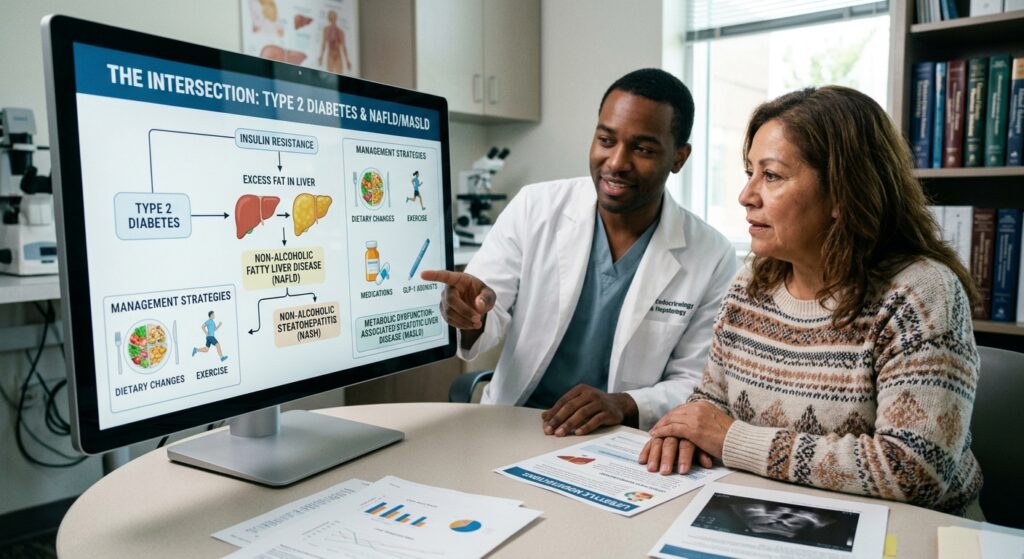
If your doctor has mentioned “fatty liver” alongside your type 2 diabetes, you’re far from alone and understanding the connection is one of the most valuable things you can do for your long term health.
You may have heard this condition called NAFLD (non-alcoholic fatty liver disease) but in 2023, medical organizations officially renamed it MASLD (metabolic dysfunction-associated steatotic liver disease). This was done to better reflect that it’s driven by metabolic issues like diabetes, not alcohol. The change came after years of concern that the old name was stigmatizing and inaccurate. You’ll still see “NAFLD” everywhere, so I’ll use both just know they refer to the same condition.
This article explains what fatty liver is and what to ask your care team and not a treatment plan. Liver health is genuinely medical territory, so use this to get informed and have better conversations with your doctor.
What is fatty liver disease?
Fatty liver disease simply means too much fat has built up in your liver. A little fat is normal; too much can, over time, cause inflammation and damage. The condition can progress from simple fatty buildup (steatosis) to inflammation (MASH, formerly NASH), then to scarring (fibrosis), and in serious cases cirrhosis or liver cancer.
The encouraging part is in its early stages, fatty liver is often manageable and even reversible with the right changes which is exactly why catching it early matters so much.
Why it’s so common with type 2 diabetes
Now understand that type 2 diabetes and fatty liver are deeply intertwined. NAFLD/MASLD affects roughly 70% of people with type 2 diabetes, and about 20% show signs of advanced liver scarring. That’s not a coincidence and the same underlying problem, insulin resistance, drives both conditions. When your body struggles to use insulin properly, it affects both your blood sugar and how your liver stores fat.
So if you have type 2 diabetes, your odds of having some degree of fatty liver are genuinely high. That sounds alarming, but knowing it means you can act on it.
The “silent” problem
Like several diabetes related conditions, early fatty liver usually has no symptoms. It’s often completely asymptomatic, with fatigue being the most common symptom when one appears. You can have it and feel totally fine that’s why screening and not waiting to feel sick is how it gets caught.

How it’s screened
Because it’s silent, doctors use simple, non-invasive tools to check your liver with no surgery needed. Common ones include the FIB-4 score (calculated from routine blood tests) and a special ultrasound called FibroScan (transient elastography) that measures liver stiffness. Screening for liver scarring is now specifically recommended for people with type 2 diabetes.
You don’t need to master these you just need to know they exist and ask whether you’re being screened.
The good news: what actually helps
The empowering part about fatty liver is that if caught early responds strongly to the same changes that help your diabetes so you’re often improving both at once:
- Lose a modest amount of weight — even 5–10% weight loss can significantly reduce liver fat
- Move regularly — exercise reduces liver fat independent of weight loss
- Manage your blood sugar — better glucose control directly helps your liver
- Cut sugary drinks and refined carbs — these drive liver fat especially hard
- Limit alcohol — even though this isn’t alcohol-caused, alcohol adds strain
- Ask about your medications — some diabetes medications (certain newer classes) can actually help the liver; your doctor can advise
Questions to ask your doctor
- “Have I been screened for fatty liver disease (NAFLD/MASLD)?”
- “What’s my FIB-4 score, and do I need a FibroScan?”
- “Is there any sign of liver scarring (fibrosis)?”
- “Could any of my diabetes medications help my liver?”
- “What weight and blood sugar targets would help my liver most?”
The bottom line
Fatty liver disease sounds frightening, and advanced cases are serious. It’s extremely common with type 2 diabetes and usually silent (so screening matters), and in its early stages it responds remarkably well to the very same healthy changes that improve your blood sugar. The people who do best are the ones who know to ask about it. You now know to ask.
This article is educational and not medical advice. Fatty liver disease requires professional diagnosis and management so always work with your doctor or a hepatologist. If you’re experiencing a medical emergency, call 911.